
 End-to-end outreach workflow




Table of Contents
- Digital PR is growing fast, with search interest rising sharply since 2021 and most practitioners saying it’s becoming more important in the age of AI.
- Getting media coverage remains the biggest challenge, but digital PR is becoming easier to sell to clients and stakeholders.
- Data-led content is the dominant strategy, and collaboration between SEO and digital PR teams continues to increase.
- Quality links remain the top KPI, with link costs rising as competition for high-authority coverage grows.
- Successful outreach depends on relevance and relationships, as journalists increasingly prioritize personalized, research-driven pitches over mass outreach.
- AI is reshaping digital PR, driving greater demand for brand visibility, citations, and data-backed content.
Tracking what’s genuinely going on in any growing industry can be challenging.
And as you’ll see, digital PR is still gaining interest fast in 2026.
Over the past few years, BuzzStream has compiled statistics from our research on the digital PR industry.
Like our link building statistics or AI statistics, these should guide your strategies or research.
Combining data from our annual State of Digital PR Report, annual reports from Muck Rack and Cision, and a bit of Google Trends, the following digital PR statistics tell the story of PR in 2026 and beyond.
Digital PR Growth
1. Interest in the search term “digital PR” has increased almost 80 percentage points since 2021. (Google Trends)
2. The UK has seen an increase of 85 percentage point since 2021, with a 127.59% since the start of 2026. (Google Trends)
3. The US has seen a 93 percentage point increase since 2021 and a 244.83% increase since the start of 2026. (Google Trends)
The industry blew up sometime during the Pandemic when Google’s John Mueller tweeted:
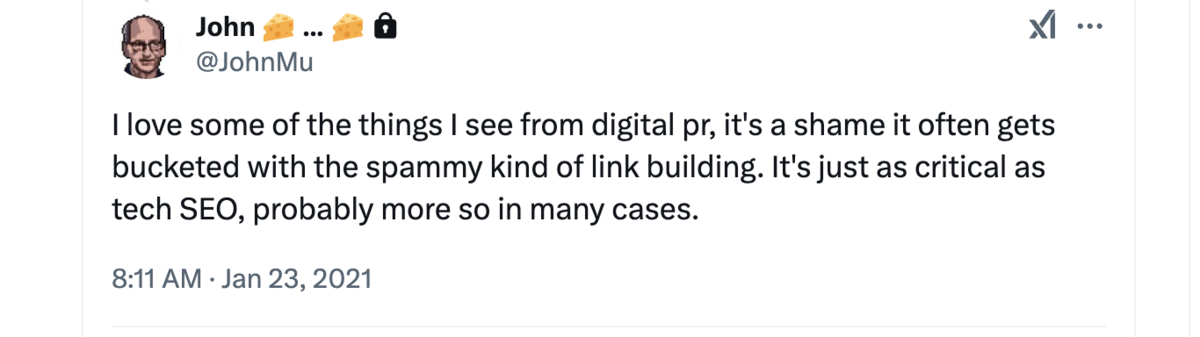
This, combined with Google’s 2024 Helpful Content Update, Link Spam Update, and foray into AI, have made PR, in general, a much more critical part of the marketing mix.
Industry Challenges
4. Three-quarters (75%) believe digital PR is more challenging in 2026 than in 2025 — a 4% increase year over year.
5. The biggest challenge is now getting coverage (26.4%), followed by measuring impact (14.9%) and keeping up with industry changes (14.2%). (BuzzStream)
6. 28.4% said it was less challenging to sell digital PR this year, up from 15% last year. (BuzzStream)
Due to the continued interest in digital PR, many new players have entered the fold. This is only adding to the competition and challenge.
But, I believe some of the best campaigns are born out of good competition. You can see some of those digital PR examples in our post.
Tactics for PRs
7. The most common tactic digital PRs use is pitching data-led content (95.9%), with pitching press releases climbing notably to 79.1%. (BuzzStream)
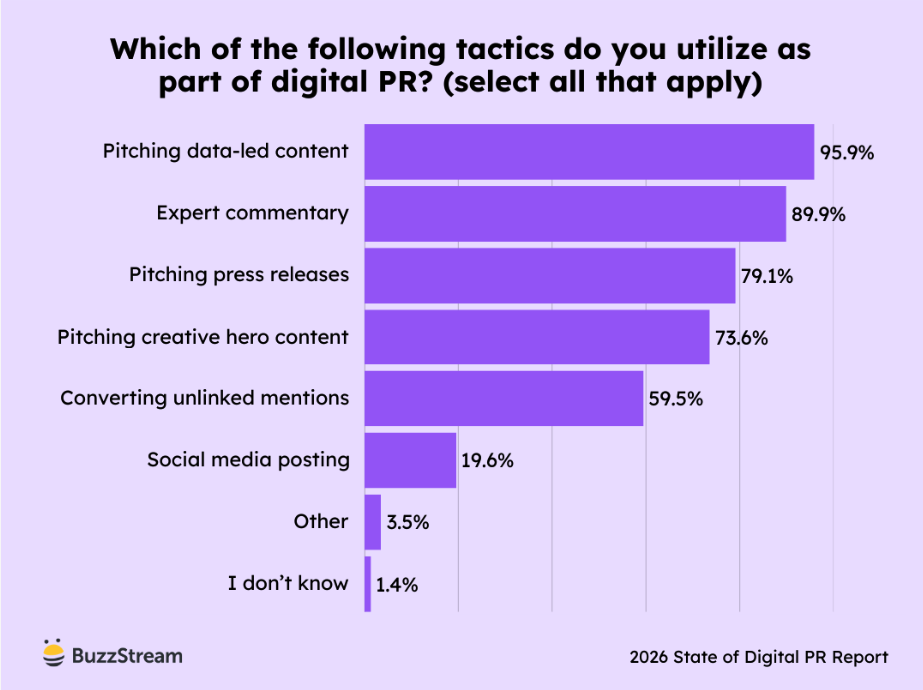
I’m glad to see data-led content is still leading the way because I believe that is where brands can combine their SEO and PR efforts for the best results.
I outlined the thinking in my post about link building in 2025.
8. Just over half (53.4%) of PRs collaborate most closely with SEO teams. (BuzzStream)
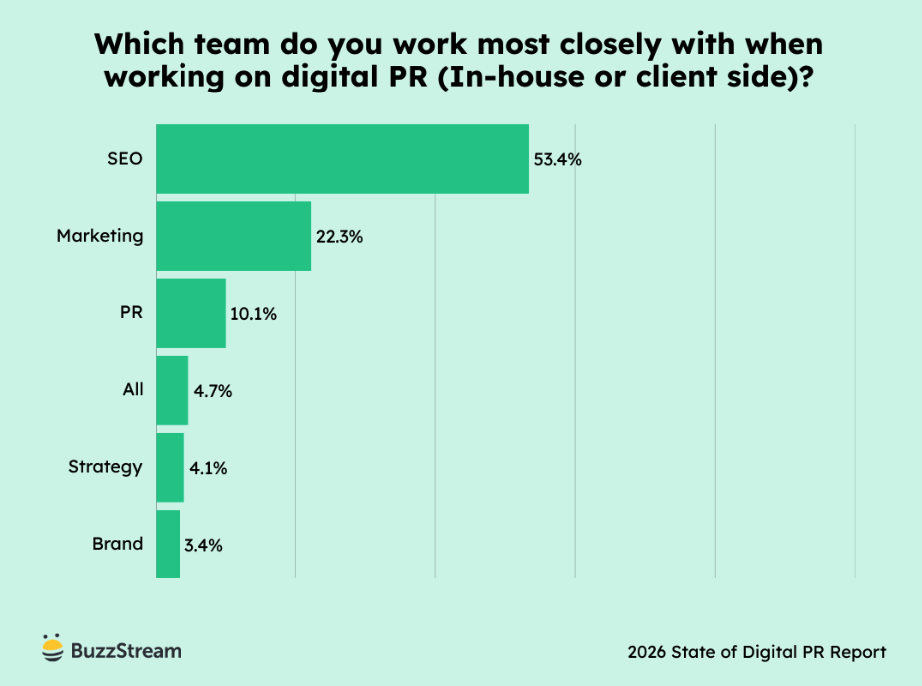
9. Fewer digital PRs now work most closely with PR teams — that share dropped from 14.5% in 2025 to 10.1% in 2026. (BuzzStream)
This is where I’d like to see the most significant change. I talked a bit about this with the creator of the P.E.S.O. model, Gini Dietrich.
Sites must realize that digital PR, SEO, and branding play together.
Costs and Budgets
10. About 60% of respondents operate with budgets under $10,000/month, and 25.7% report less than $5,000/month. (BuzzStream)
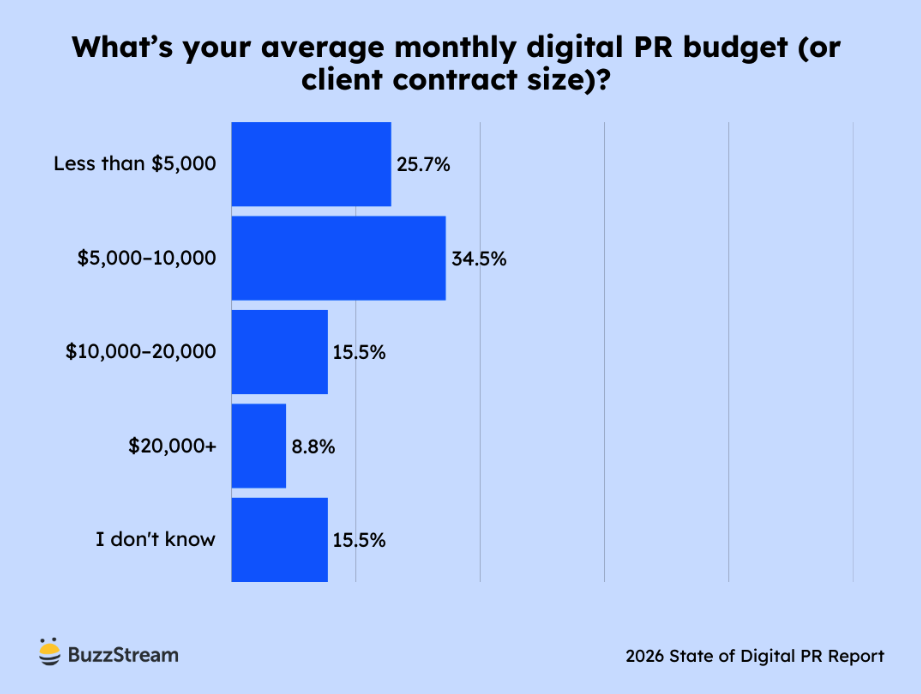
11. The share with budgets exceeding $20,000/month more than doubled, from 4% to 8.8%. (BuzzStream)
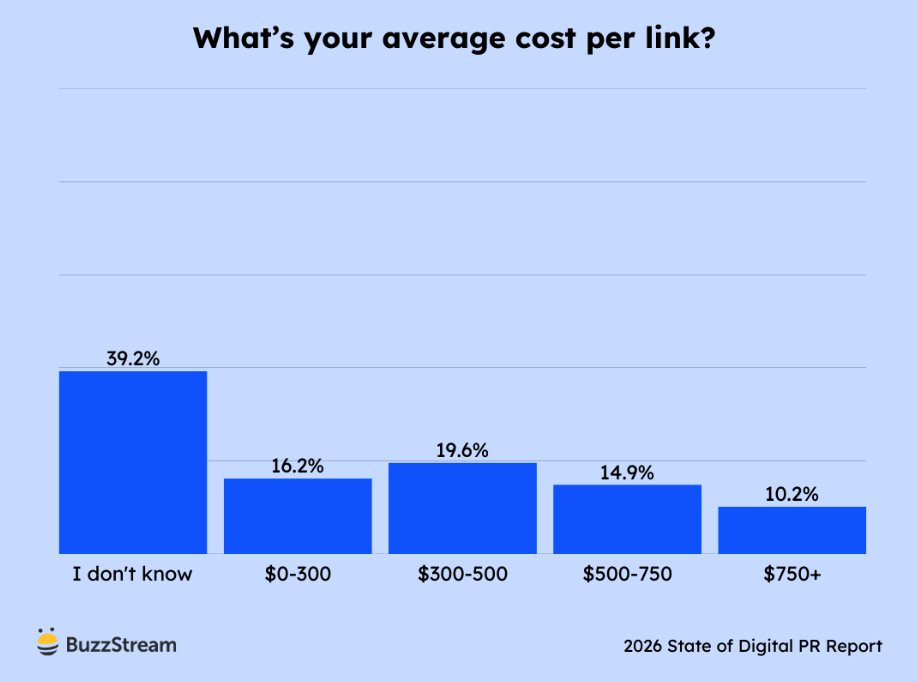
12. The most common known cost per link is now $300–$500 (19.6%), and the share reporting $750+ surged from 3% to 10.2% — a sign link costs are rising. (BuzzStream)
13. In 2026, 32.5% of digital PRs say a single team member can generate 31+ links per month — about one link per working day. (BuzzStream)
$750 per link is an extreme bargain these days.
The value of a link has shot up due to a combination of factors, including fewer high-quality sites, journalist layoffs, and more digital PRs working in the space.
You can read more about this in my post on the Helpful Content Update’s impact on quality sites.
With a $10,000/month budget, you’ll expect to get ~13 monthly links based on this breakdown.
If they are high-quality, highly relevant links, they can significantly impact your brand’s rankings and visibility.
14. In our study, about 40% of respondents don’t know their average cost per link. (BuzzStream)
As much as brands should think more broadly about their KPIs, links still dominate the conversation. And within the link conversation, there will always be CPL.
So, even if you don’t like it, it’s probably worth figuring out if you hope to sell services.
In our link building pricing post, we explained how different agencies consider their cost per link.
KPIs for Digital PR
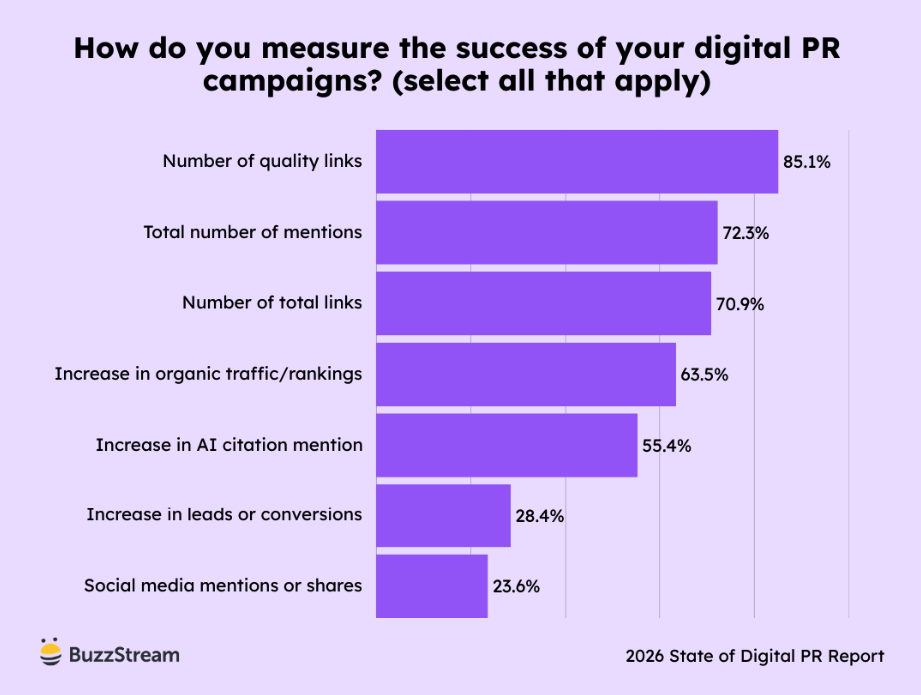
15. Number of quality links is still the top success metric (85.1%), followed by total mentions (72.3%) and total links (70.9%). (BuzzStream)
16. Ahrefs Domain Rating (DR) is the number one authority metric, used by 93.2% of digital PRs (up from 83.3% last year). (BuzzStream)
17. Only about 12% use Ahrefs UR or URL Rating. (BuzzStream)
18. Moz Domain Authority (DA) gets used by 30.4%, with less than 0% using Page Authority (PA). (BuzzStream)
19. Majestic’s Trust Flow (TF) is used by 13.5% and Citation Flow (CF) by 7.4%. These are increases since last year (BuzzStream)
When analyzing the impact of digital PR, quality reigns supreme. There are plenty of metrics out there for determining link quality.
In the next stat, you’ll see how relevance is gauged.
Link Relevance
20. 62.2% believe that the page/post title and anchor text are the top ways to evaluate a link’s relevance. (BuzzStream)
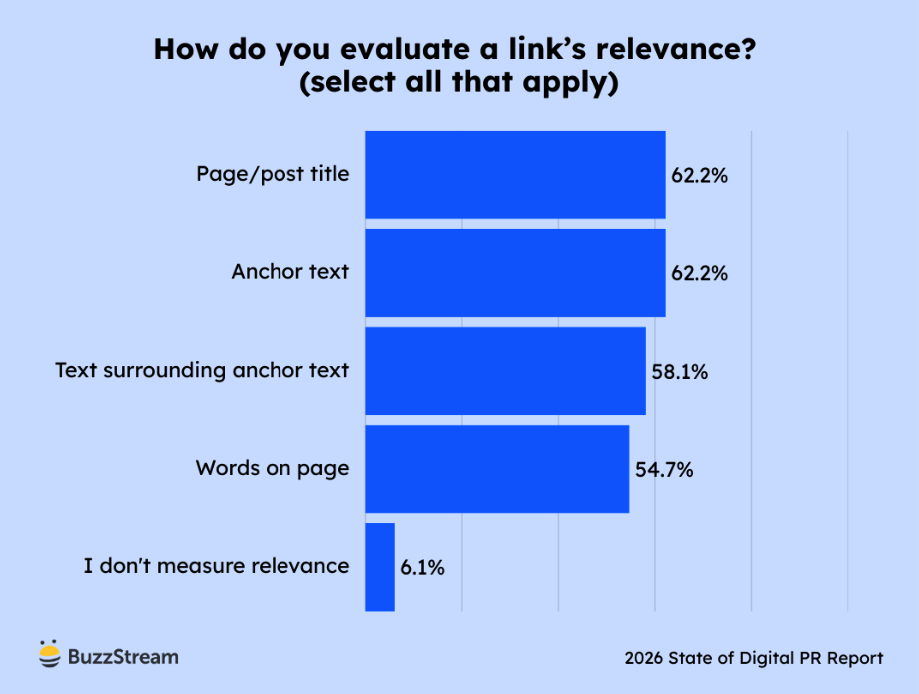
21. 6.1% of digital PRs don’t measure relevance at all (a welcome drop of 4% from last year). (BuzzStream)
The page title is only one way to gauge relevance.
The Google leak showed us how vital anchor text and surrounding context are in determining a link’s relevance. This surrounding text is also incredibly important in the context of AI exposure. (Check out our webinar with the team at Citation Labs for more on this.)
Paid Placements
22. About 80% of digital PRs never pay for link placements, down from 87.3% last year. (BuzzStream)
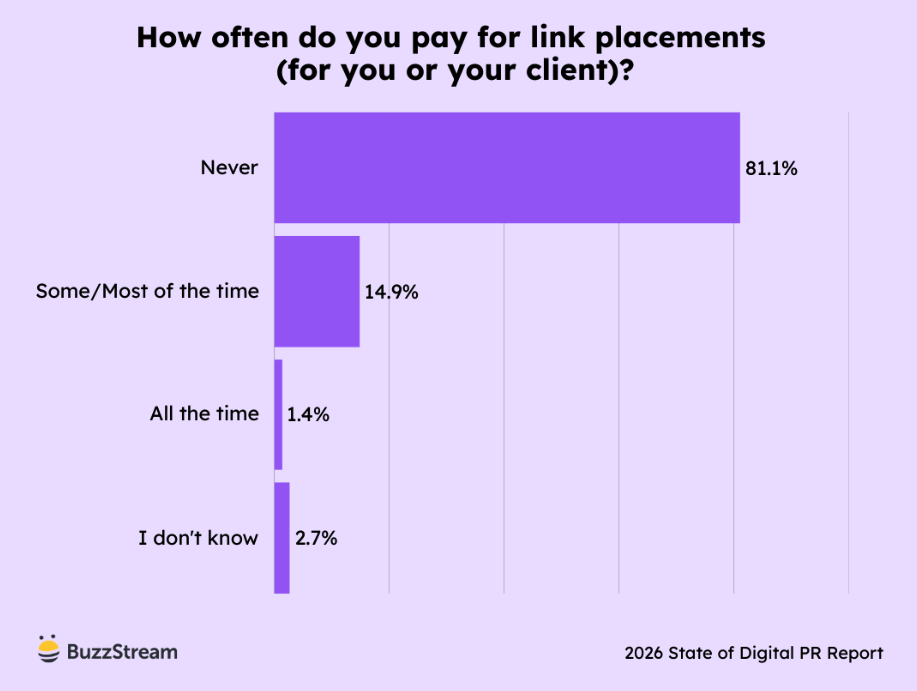
23. Over 90% believe hitting client goals is possible without buying links. (BuzzStream)
This is excellent news for PRs and bad news for link marketplaces. Most marketplaces provide very low-quality, low-impact placements.
After analyzing thousands of guest posts, I concluded that only 6% were actually valuable in that they had a high DA and high traffic (and those two metrics don’t take into account things like relevance).
Statistics About Results
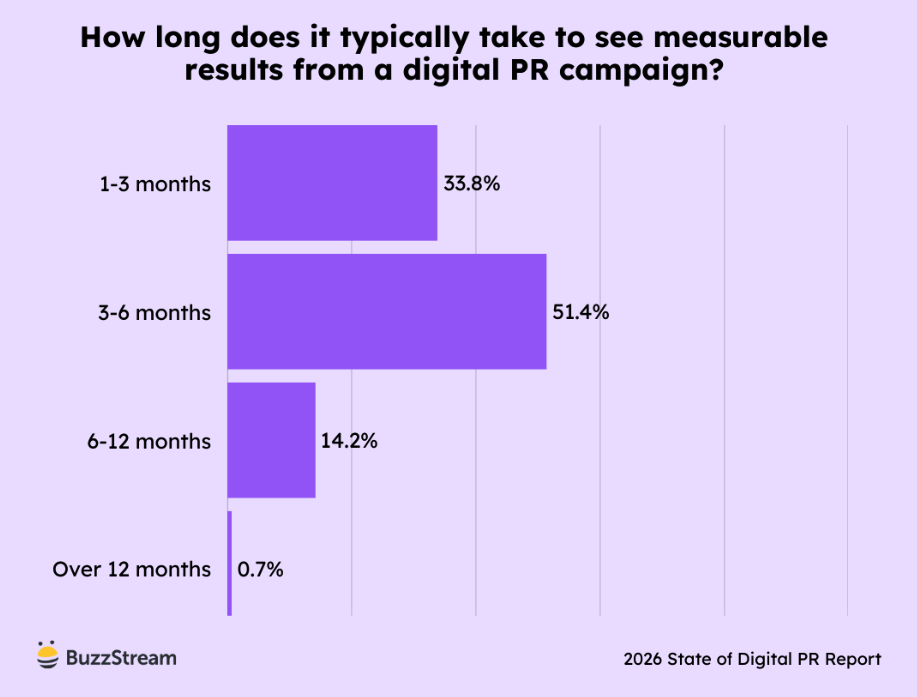
24. 85.2% say it takes no more than 6 months to see measurable results, with 51.4% reporting 3–6 months. (BuzzStream)
25. 68.2% believe digital PR is more effective than it was 12 months ago (about a 20% jump from 2025!) (BuzzStream)
26. 33.8% believe it takes an even shorter time, at 1-3 months. (BuzzStream)
Our research showed that some PRs can generate upwards of 31+ links per month, which can supercharge a site and cut the time it takes to see results.
That said, “results” do differ depending on many factors. You need sound on-page SEO and technical SEO to reap the benefits of digital PR.
In our SEO and digital PR analysis, we’ve seen significant increases in organic traffic for sites from links earned through digital PR.
Industry-Specific Stats
27. Finance is now the toughest industry to build links in (23.6%). (BuzzStream)
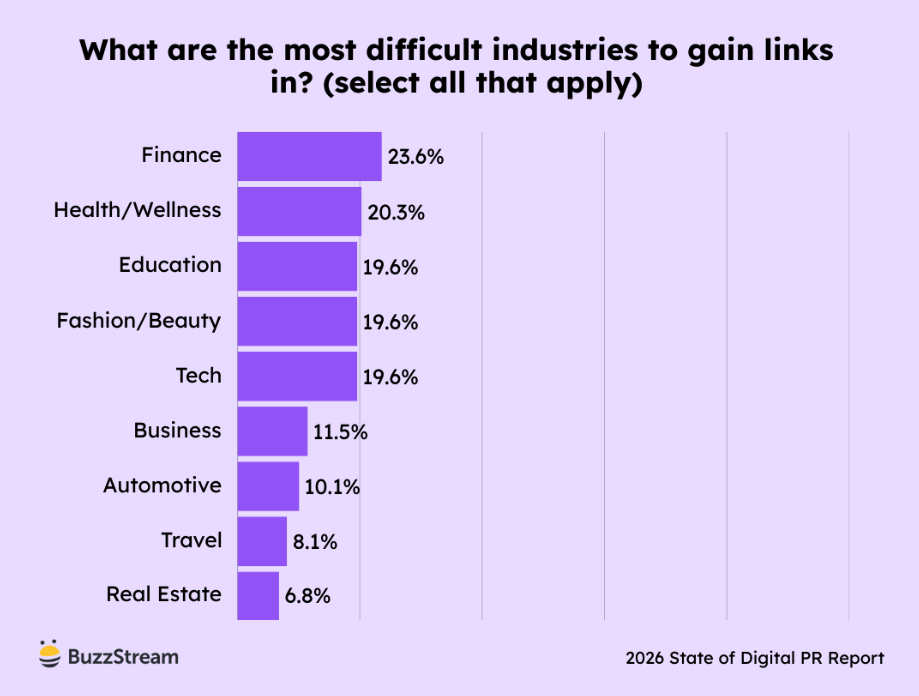
28. Travel is once again the easiest industry to gain links in (46.6%). (BuzzStream). (BuzzStream)
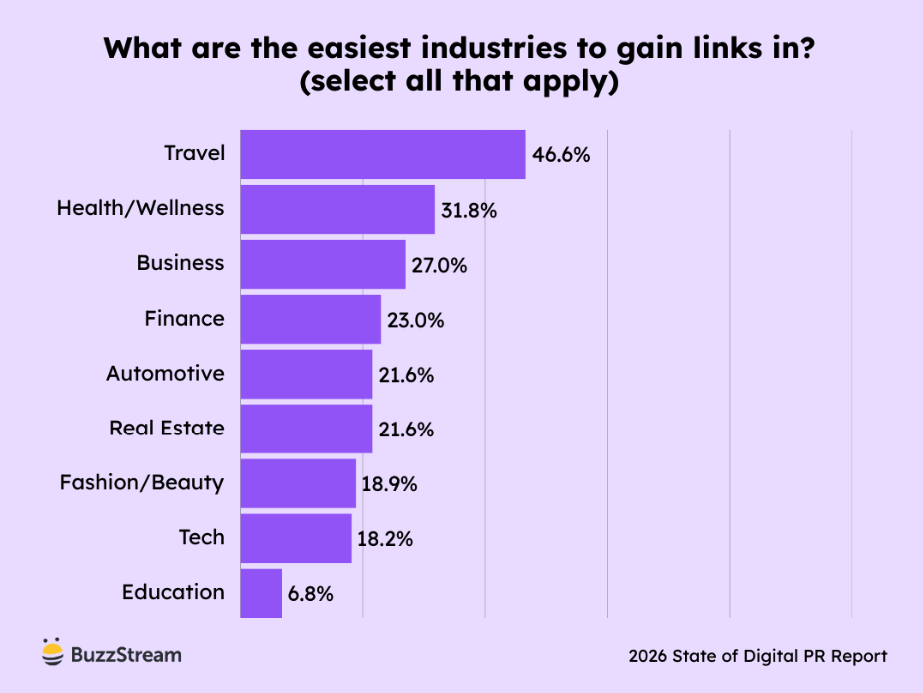
These results may change your thinking about a link’s value in these industries.
The harder it is to get a link, the more costly it is to build.
Digital PR Tools
29. Muck Rack (46.6%) and BuzzStream (44.6%) are the top media-list building tools. (BuzzStream)
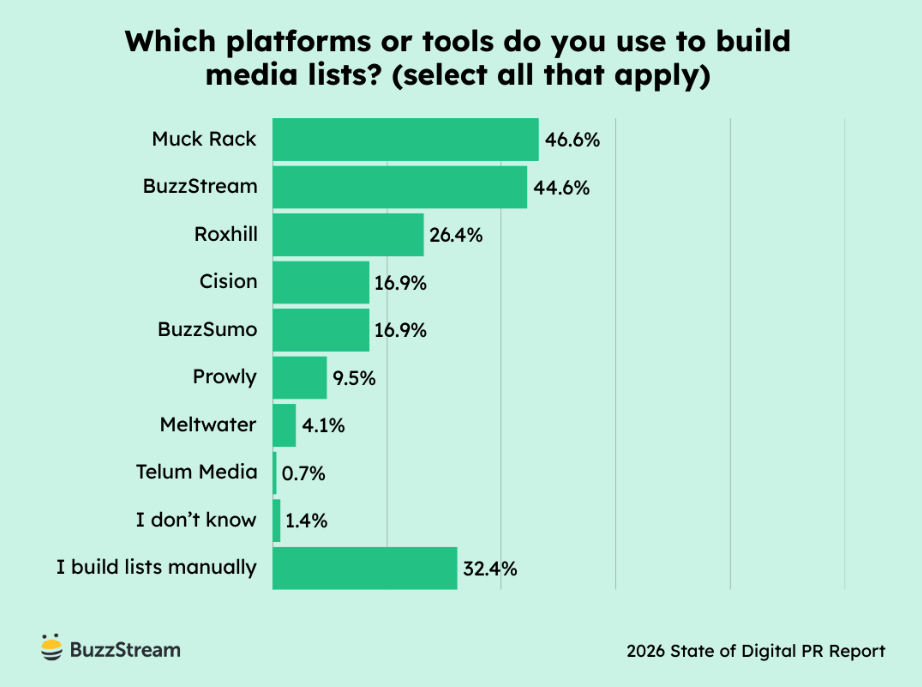
30. The biggest challenge with media-list tools remains outdated or incorrect journalist information (62.8%). (BuzzStream)
Our media databases study showed why Muck Rack consistently ranks among the most-used list-building tools: its accuracy.
31. The most popular digital PR email outreach tool is BuzzStream 🐝 (52%). (BuzzStream)
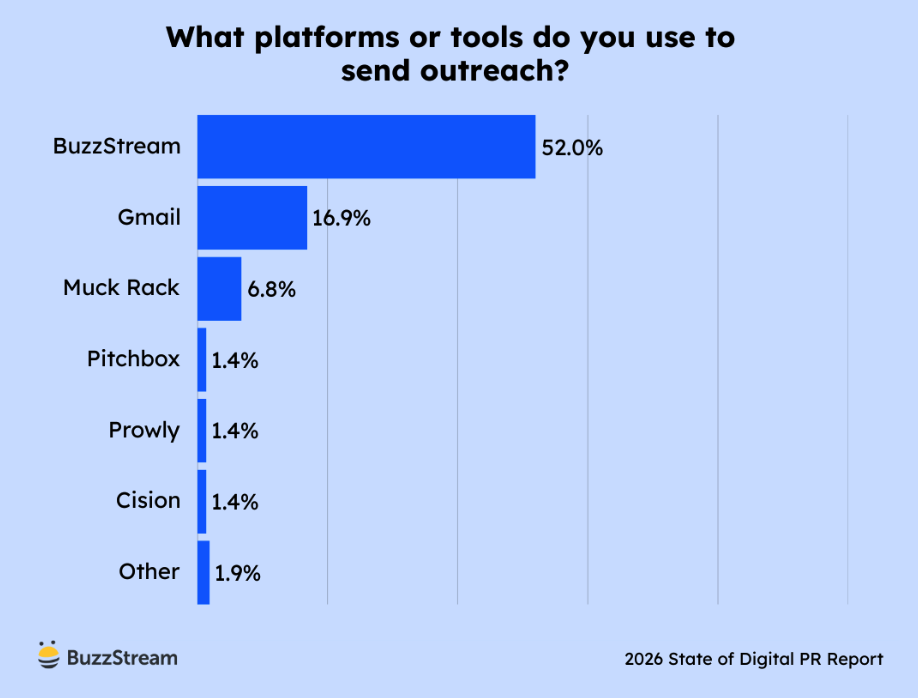
32. Around 17% rely on Gmail for outreach, up 13% from last year. (BuzzStream)
The fact that link builders and PRs are still using Gmail shows me they aren’t taking advantage of opportunities to build relationships with journalists.
Email outreach tools like BuzzStream provide valuable contact history to help you get repeat links from top-tier publications.
Pitching Journalists
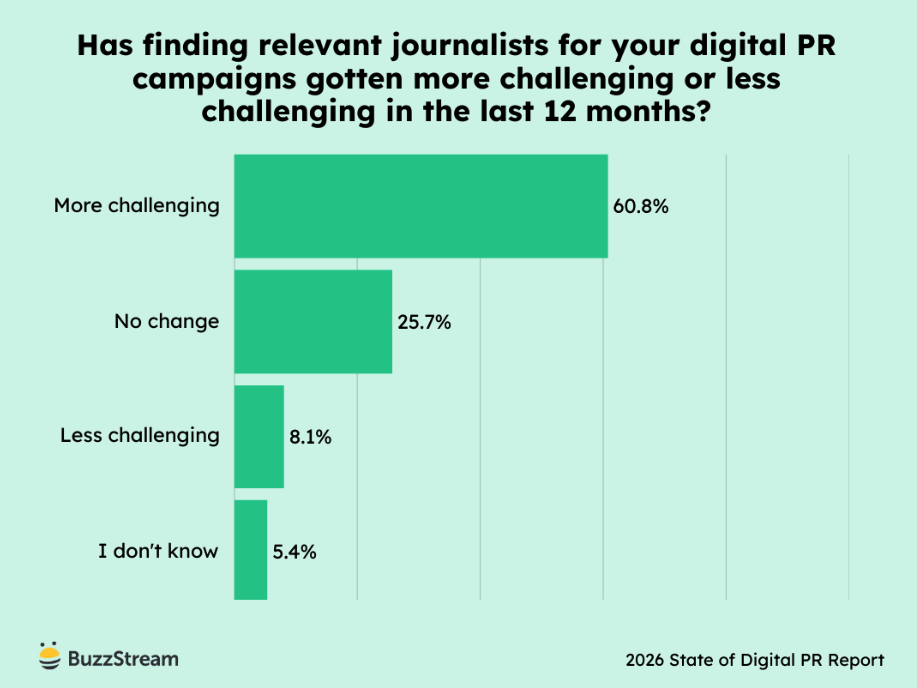
33. 60.8% of digital PRs say finding relevant journalists is more challenging in 2026 than in 2025. (BuzzStream)
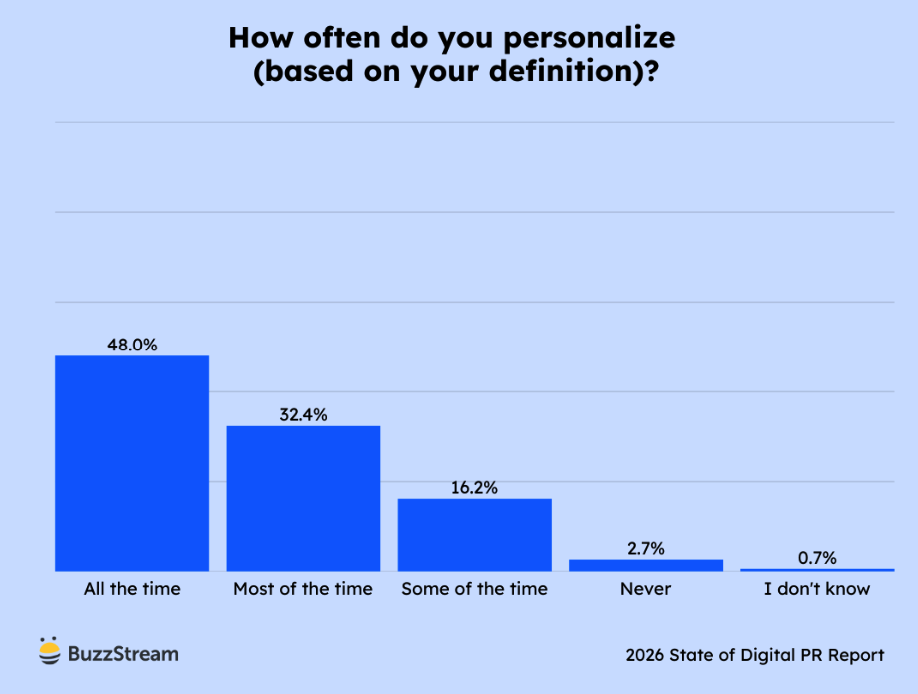
34. Just about half of digital PRs personalize their email pitches all of the time. (BuzzStream)
35. 72% of journalists agree that spamming a journalist with irrelevant information is the top way to get them to block you or add you to their “don’t call” list. (Cision)
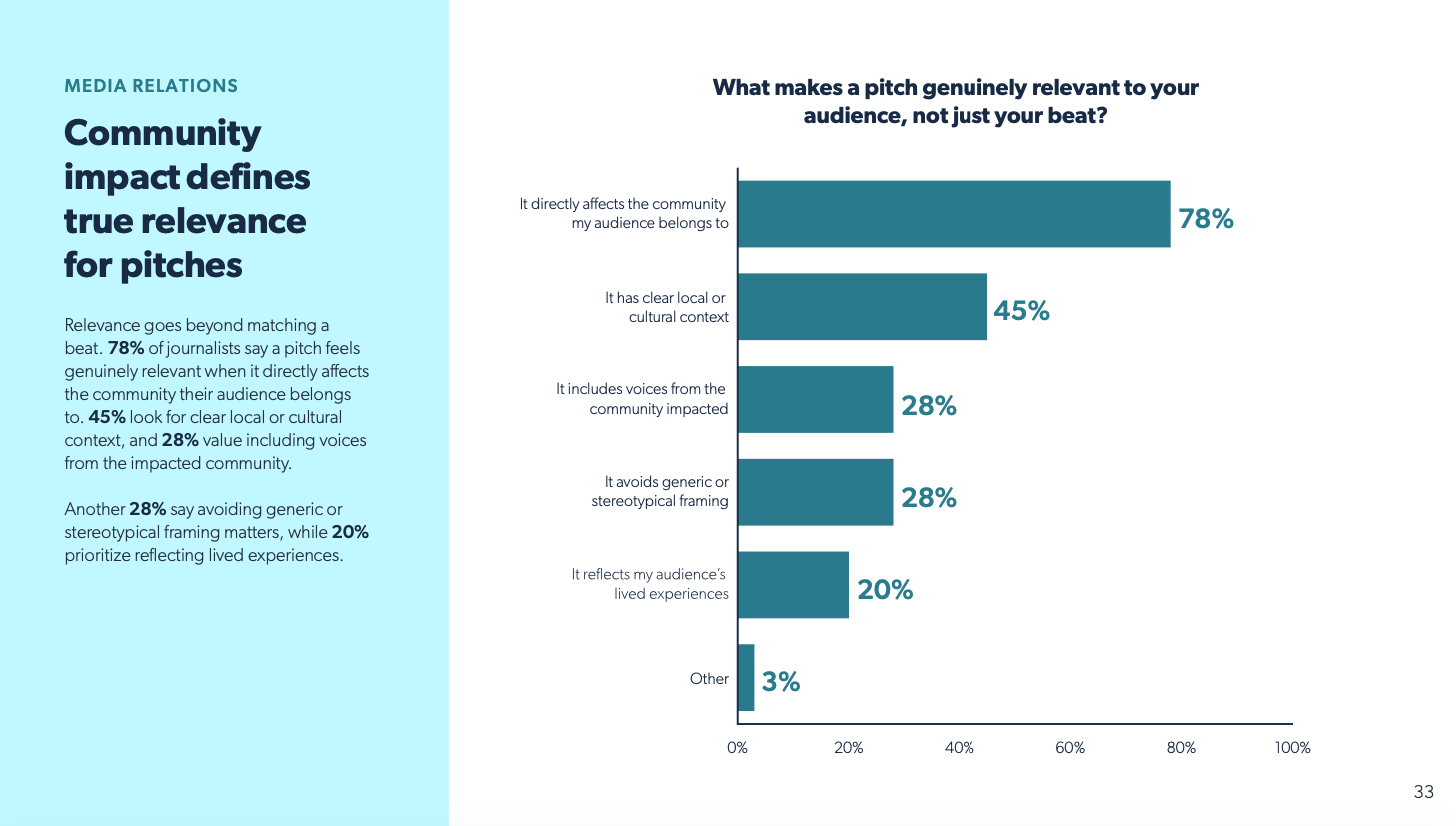
36. 78% of journalists say relevance to the community their audience belongs to makes a pitch genuinely relevant. (Cision)
That’s according to Cision’s State of the Media report in 2026.
37. 88% of journalists say they immediately disregard pitches that don’t match their coverage area. (Muck Rack)
It’s increasingly critical to identify a journalist’s fit before emailing. You can read about how to find the right journalists in our post.
Then, we’ve also outlined several personalization methods that can help.
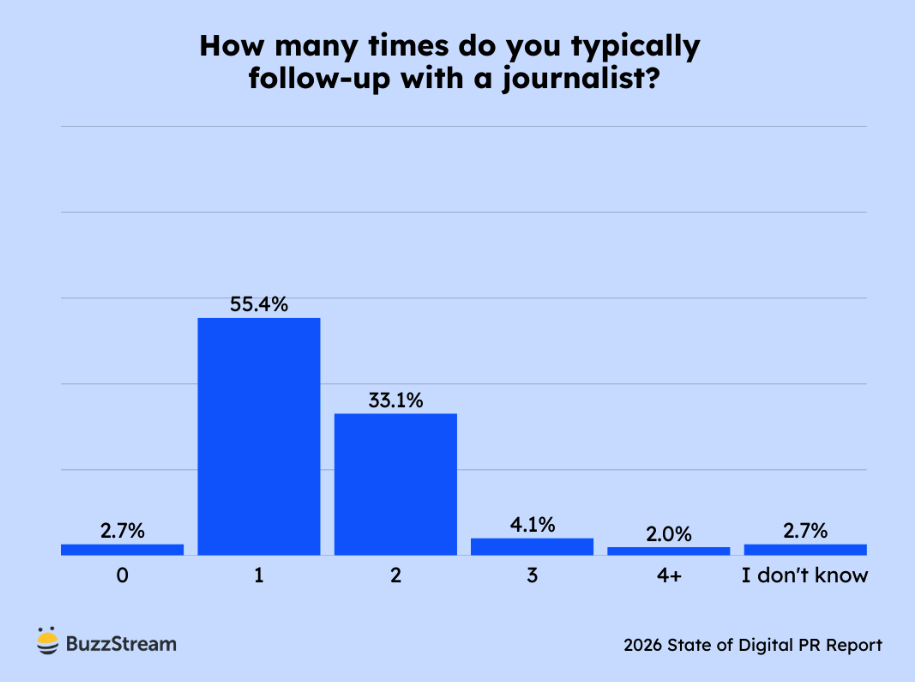
38. 55.4% of PRs only send one follow-up email to journalists. Only a third (31%) send two follow-up messages. (BuzzStream)
39. According to journalists, 64% believe you should only follow up once. (Cision)
40. 8% say you should never follow up! (Cision)
The follow-up email is a topic that is frequently discussed in PR circles. However, it seems like the single follow-up is the way to go—and potentially never.
We’ve outlined some follow-up email tactics in our email outreach templates post.
Newswire Services
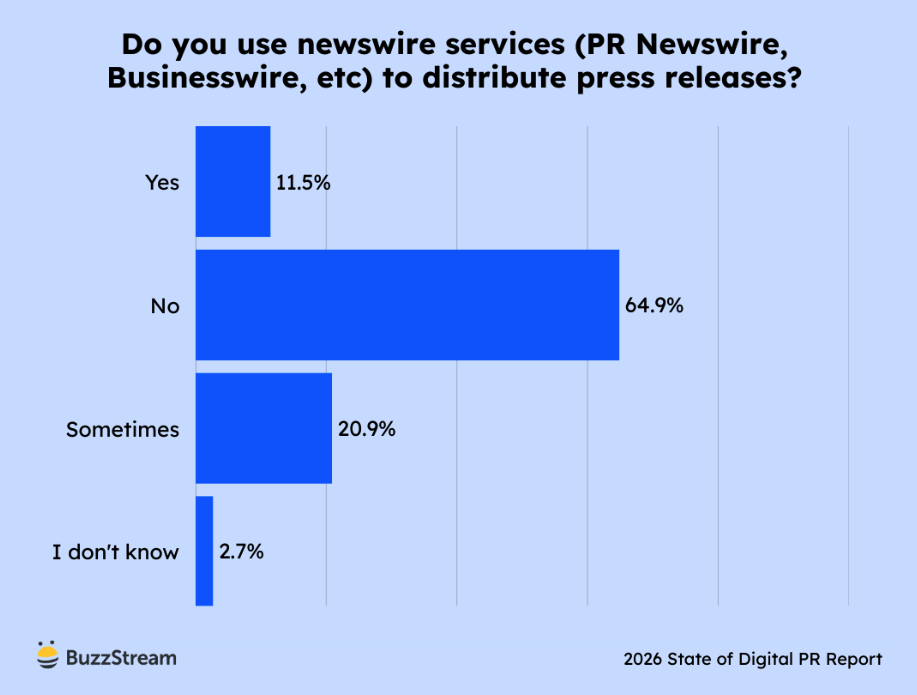
41. Only 11.5% use newswire services to distribute press releases. (BuzzStream)
42. One in four journalists pick up stories from distribution services in 2024. (Cision)
As outreach tactics go, newswire services don’t seem to be as popular.
Journalist Relationships with Digital PRs
43. 53% of journalists say their relationships with PR professionals are important or very important to their success (30% very important, 23% important). (Muck Rack)
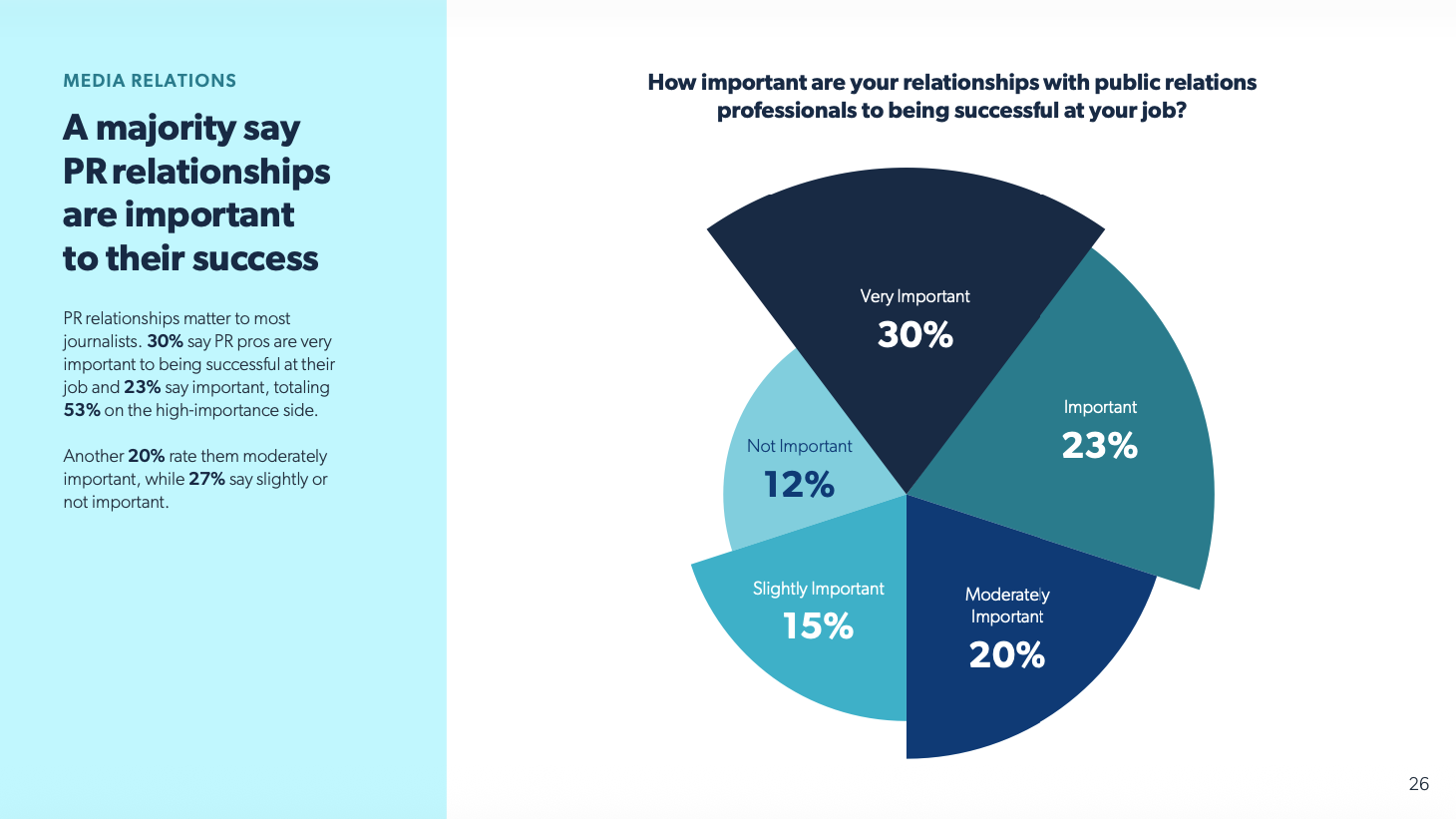
This is excellent news for PRs and all the more reason to invest time and energy into building meaningful relationships with PRs.
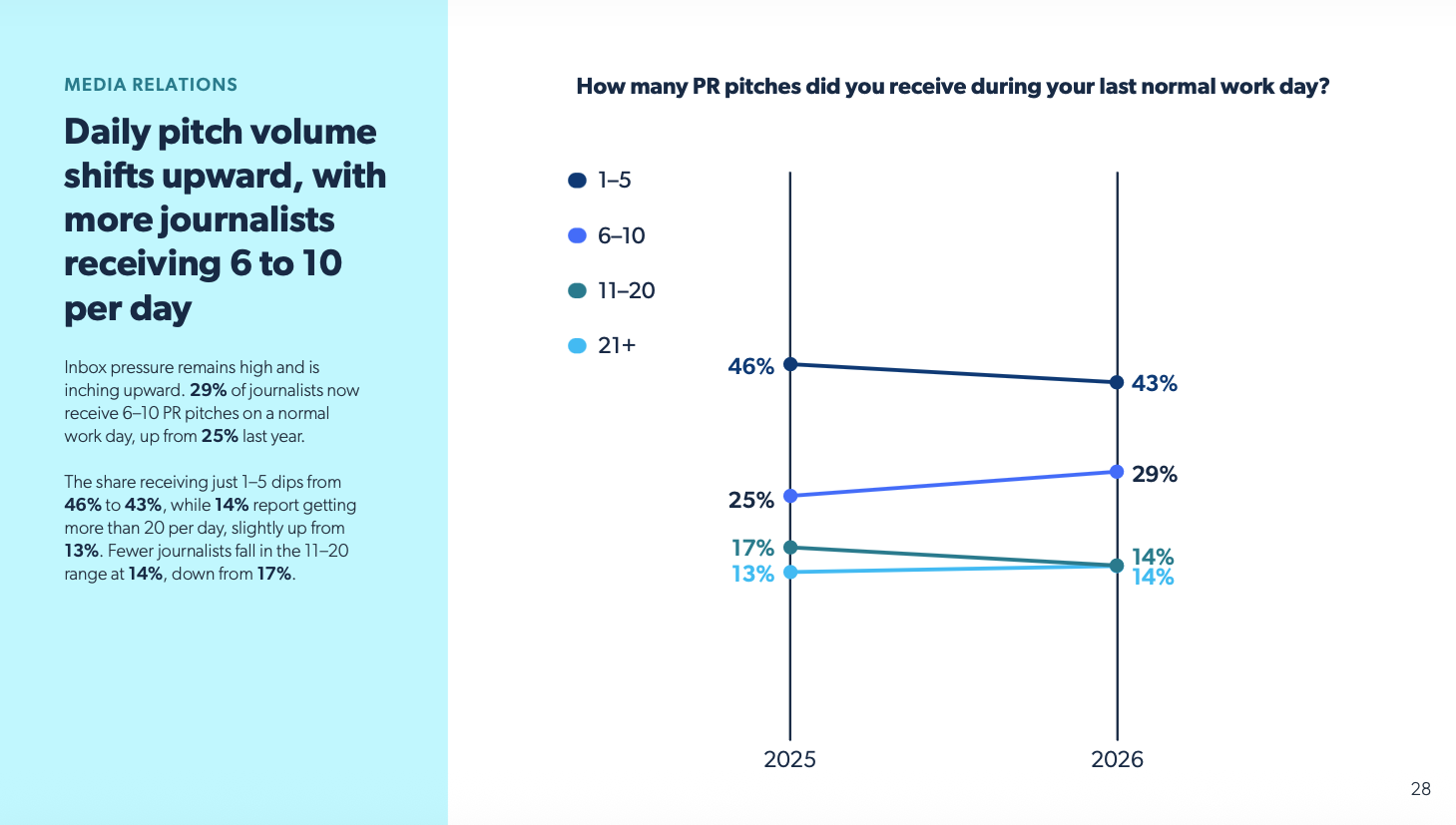
44. 29% of PRs receive 6-10 pitches per day (up 4% from last year). (Muck Rack)
45. 72% of journalists receive more than 50 weekly email pitches. (Cision)
46. 54% of journalists say they seldom or never respond to a PR pitch. (Muck Rack)
With stats like this, it may be tempting to send numerous follow-ups. But in most cases, if your pitch is relevant to their beat and eye-catching, a journalist will find it.
47. Digital-only outlets are now the most common workplace type for journalists (25%). (Muck Rack)
image
Digital is the future of journalism. This may be one of the driving factors in the growth of interest in digital PR.
What Journalists Want
48. The content journalists most want more of from PRs has flipped toward data: 47% want data or research, 45% want embargoed or early-access information, and 42% want access to experts. (Cision)
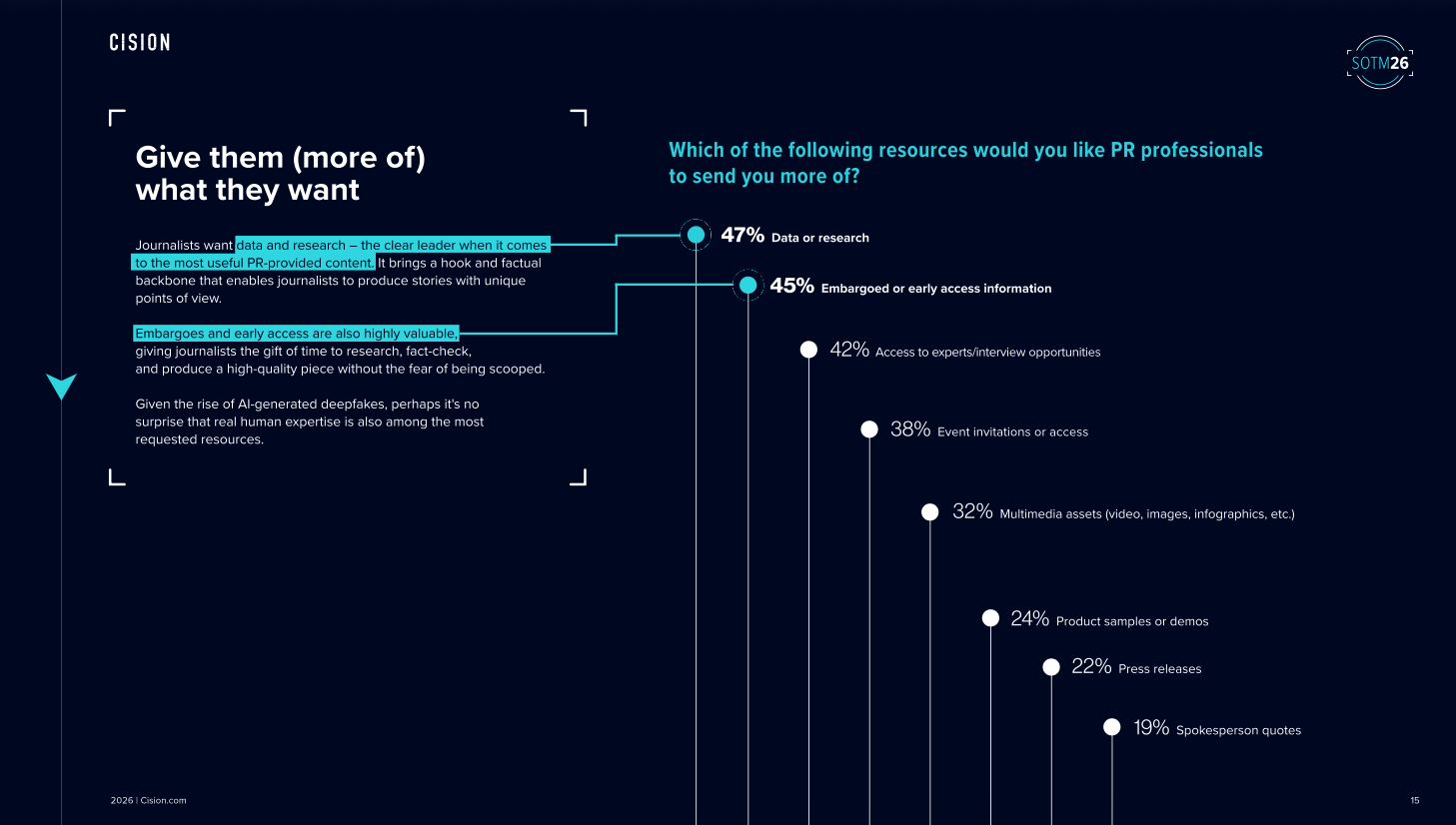
49. 47% of journalists said that original research reports (trends, market data, etc.). (Cision)
As seen at the beginning of this post, this directly aligns with digital PR’s main tactic: data-led content.
50. Journalists say that press releases (68%) are most valuable for generating content or ideas, followed by direct pitches (47%) and industry experts (47%). (Cision)
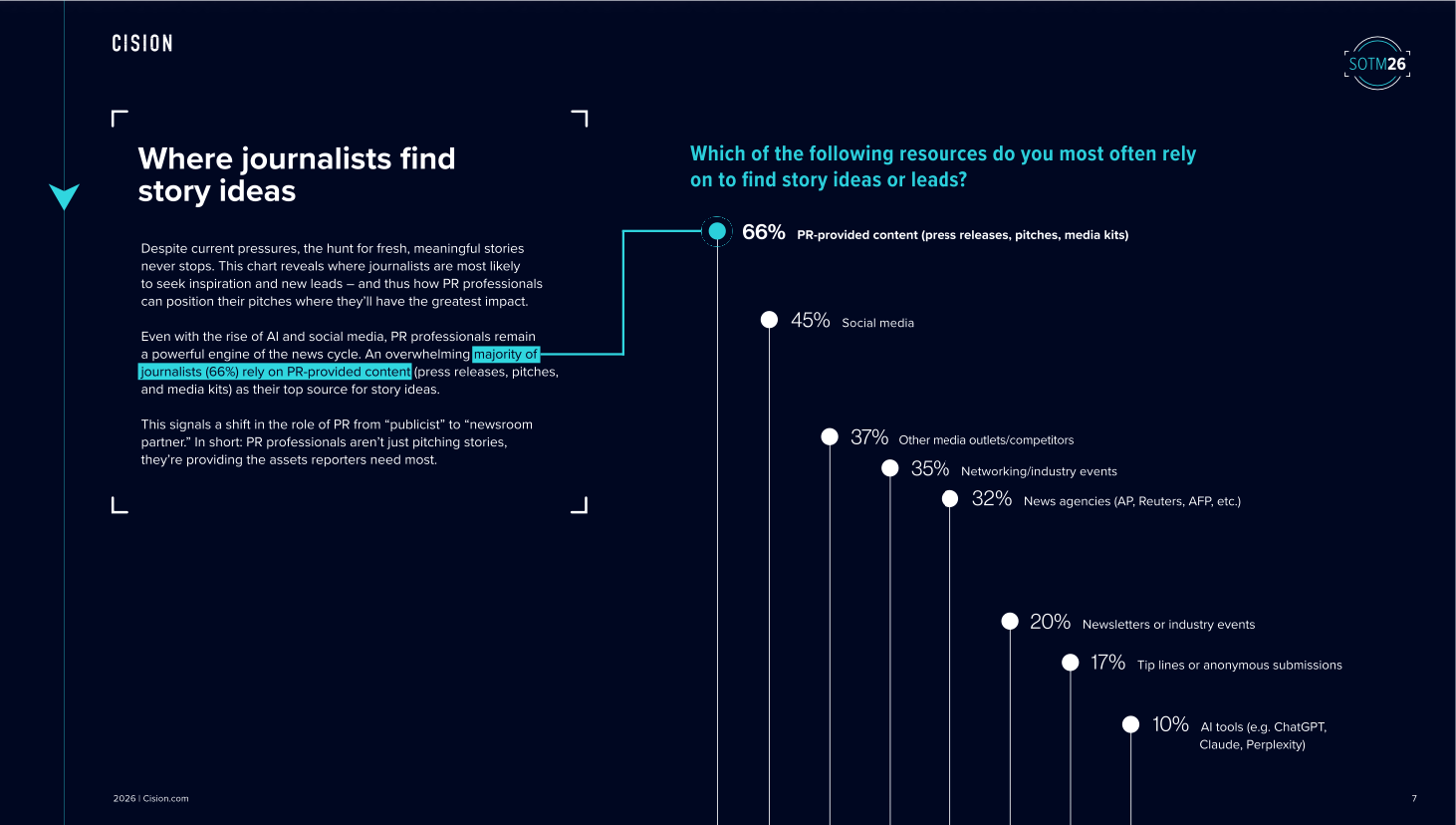
When pitching news to journalists, come prepared with a press release and expert quotes.
You can see the key components required in our anatomy of a release post.
Lastly, when pitching, journalists seem to reuse images. Data visualizations, not so much.
AI in Digital PR
51. 83.1% say that digital PR is more important in 2026 due to AI. (BuzzStream)
52. Under half (41.2%) use AI in their pitch writing process. (BuzzStream)
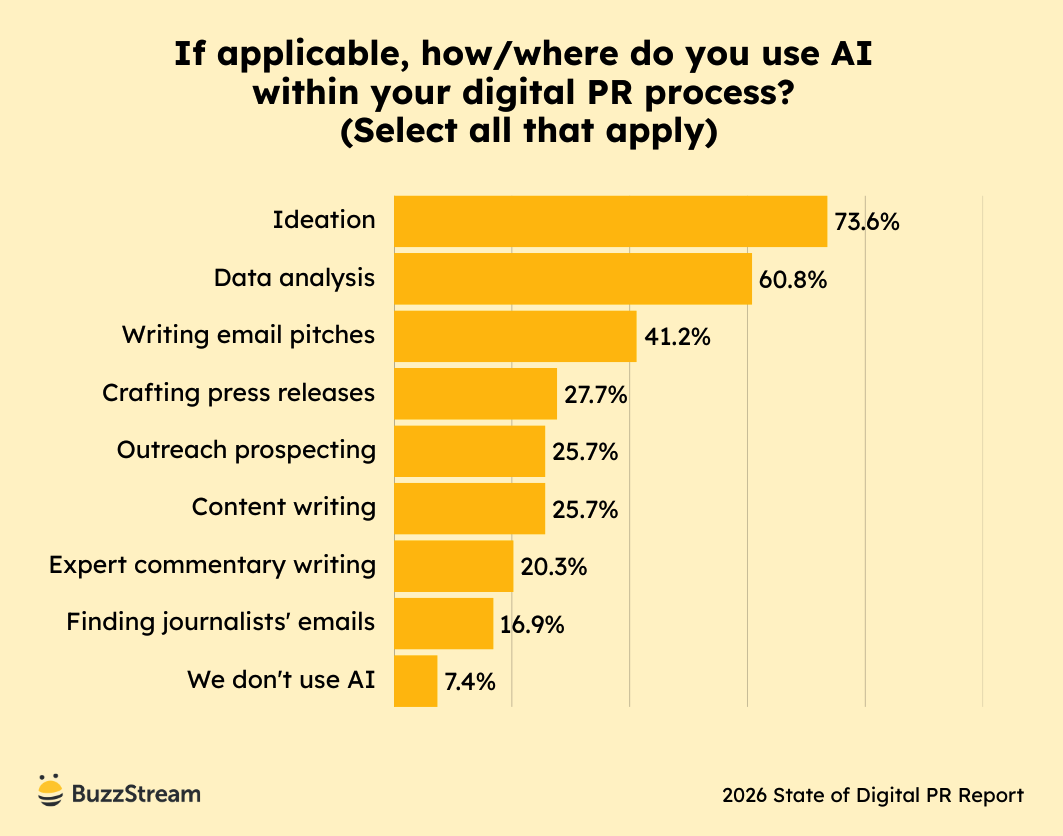
53. Only about 40% say they have a repeatable way of getting clients’ brands cited in AI using digital PR. (BuzzStream)
54. About half (52.0%) say they use Ahrefs Brand Radar as their tool of choice for tracking AI citations. (BuzzStream)
52. The most common way digital PRs use AI is in their ideation processes (73.6%). (BuzzStream)
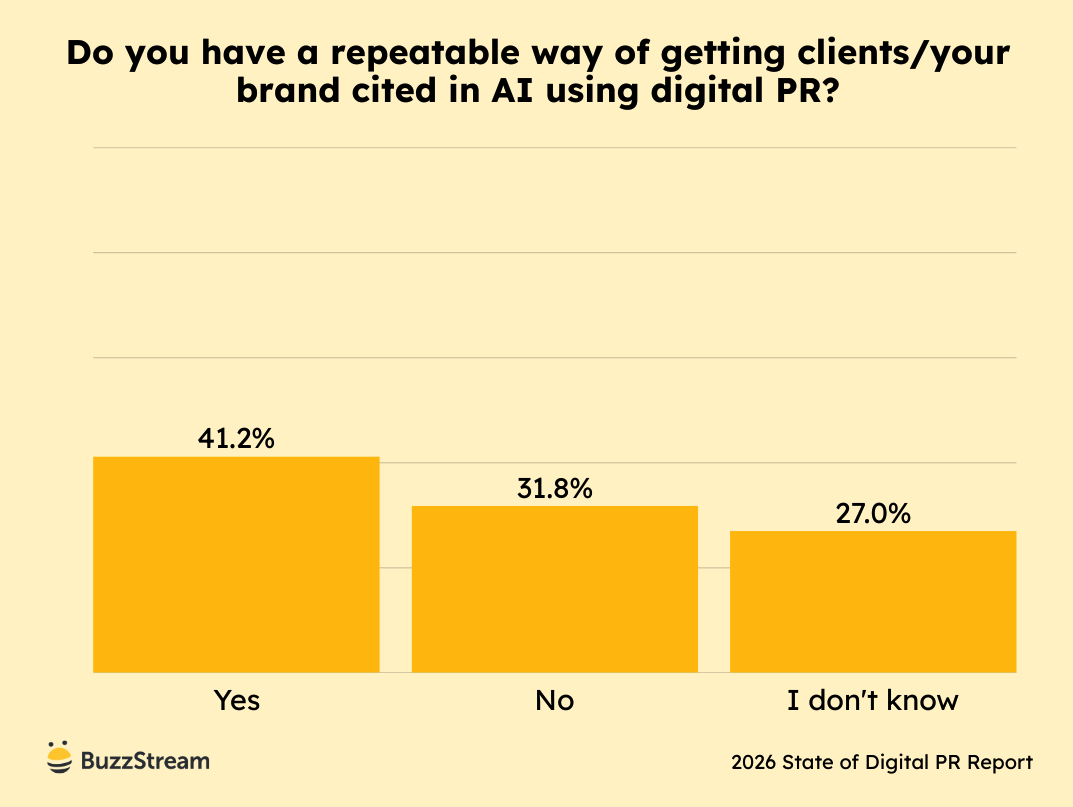
As the digital PR community continues to learn more about how AI technology works to mention and cite brands, I expect to see these numbers jump way higher.
BuzzStream has been gathering extensive data on how news publications cite brands and how prompt type influences citations.
Take Statistics With a Grain of Salt
Remember, these statistics tell a story but don’t apply to every brand. Google still has the power to dictate the effectiveness of a lot of what link builders do.
The beauty of digital PR is that it can transcend the boundaries of SEO and promote the brand.
Don’t know where to go from here?
Get started by reading our digital PR primer.


 Check out the BuzzStream Podcast