
 End-to-end outreach workflow




Table of Contents
- Average guest post link costs $461; high-quality posts average $3130 based on traffic and DA/DR benchmarks.
- Link insertions average $179 but are rarely offered by high-quality, high-traffic sites.
- Digital PR links cost $1,250–$1,500 per link and remain the most valuable for authority and rankings.
- Only 1.37% of guest post opportunities meet quality standards—Google devalues most low-cost options.
- Link lifetime value varies by industry—finance commands higher ROI and justifies greater link investment.
Most backlink pricing posts today just hand out a number and call it a day.
But that doesn’t really tell you much.
An average that blends a $20 link insertion with a $10,000 guest post news placement can essentially justify any cost.
Today, a backlink’s price is set by the site’s authority, like Domain Rating (DR), organic traffic, the industry, and how much work it takes to actually land the link.
In our data, a DR 80+ link insertion costs about four times as much as a DR 0 to 9 insertion ($461 vs. $113).
This is an updated 2026 version of this post, rebuilt with data from our guest post cost, link insertion cost, and digital PR cost analyses.
I’ll break down what a backlink costs in 2026 by DR, traffic, method, and industry; what agencies charge; and how to tell whether a quote is fair.
How Much Do Backlinks Cost?
Here is how much backlinks cost in 2026:
| Link type | Average cost per link | Typical range | What you get |
|---|---|---|---|
| Link insertion | $179 | $20 to $1,500 | Your link added to an existing article |
| Guest post (direct from site) | $295 | $150 to about $10,000 | A new article with your link, published on the site |
| Guest post (via vendor) | $461 | $150 to about $10,000 | Vendor writes, places, and publishes the article |
| Digital PR | $1,250 to $1,500 | $5,000 to $10,000 per campaign | Editorial links from news and industry sites |
(Prices as of Oct 20, 2026, from BuzzStream’s own studies linked throughout the post.)
What Goes into the Price of a Backlink
Six things set a link’s price: authority, traffic, industry, the work involved, who you buy from (agency or marketplace), and whether you buy the link or earn it.
I’ll get into each factor below, but it breaks down like this:
| Factor | Effect on price |
|---|---|
| Domain authority (DR) | Higher DR costs more |
| Site traffic | Higher traffic costs more |
| Industry | Sports costs the most; law and health cost the least |
| Content creation | Adds cost |
| Who you buy from | Vendors/agencies add a markup |
| Bought vs. earned | Earned placements cost the most per link |
These prices may stack depending on where you get your link.
Next, let’s look at some pricing models.
Link Building Pricing Models You Should Know
How you pay changes what you pay.
There are four real models these days:
| Model | How it works | Typical price |
|---|---|---|
| Per link (marketplace) | You pay a fee per placement | $179 to $461 average |
| Per link (agency, editorial) | Agency quotes each placement | $600 to $1,500 |
| Per campaign (agency) | One campaign, scoped upfront | $5,000 to $10,000 |
| Retainer | Agreed-upon link number within timeframe | $2,500 to $10,000 a month |
Let’s break down these models a bit.
What agencies charge per month
Most agencies don’t sell links one at a time.
They sell monthly retainers or campaigns with an estimated link-acquisition goal.
I did some digging to see if I could find some actual retainer costs because many don’t publish.
Published retainers can run anywhere from $2,500 to $10,000 a month, and the typical agency tier is $2,500 to $5,000 for roughly 4 to 10 links.
| Tier | Monthly fee | Links per month | Source |
|---|---|---|---|
| Low-competition or local | $500 to $1,500 | 2 to 5 | eSEOspace |
| Entry/starter | $2,500 to $3,500 | Roughly 4 to 10 | Stellar SEO, eSEOspace |
| Growth / mid-market | $5,000 to $7,500 | Not stated* | Stellar SEO |
| Competitive niche (SaaS, finance, legal, health) | $3,000 to $10,000 | Not stated | eSEOspace |
| Top-tier/enterprise | $10,000+, up to $15,000 | Not stated | Stellar SEO, Discovered Labs |
*Although these links are not stated, roughly, the more links you buy, the less each one costs.
Ask every vendor the same questions
Whatever model you choose, I’d recommend asking every vendor the same question:
“What is my cost per link, and what DR and traffic will those placements have?”
A $6,000 retainer that delivers 15 DR 20 links is a very different buy than one that delivers six DR 60 links.
I always recommend focusing on quality links over quantity.
You also want to push for relevant links.
Next, let’s look at these average costs per link.
What is the Average Cost Per Link?
The typical price of a link you can buy from a vendor is about $500.
The full range runs from under $200 for a link insertion to $3,000+ for a DR 80 guest post ($2,983).
But so much goes into these numbers that it’s hard to give one single figure.
So, let’s dig into the costs for link insertions, guest posts, and my favorite, digital PR.
Link Insertion Cost by DR
Here are link insertion prices per site across vendors, based on our analysis of 62,916 sites in a link marketplace database.
| DR range | Average cost |
|---|---|
| 0 to 9 | $113 |
| 10 to 19 | $144 |
| 20 to 29 | $188 |
| 30 to 39 | $246 |
| 40 to 49 | $197 |
| 50 to 59 | $212 |
| 60 to 69 | $296 |
| 70 to 79 | $411 |
| 80+ | $461 |
The top is thin: only 120 sites (0.19%) sit at DR 80+.
But realistically, traffic tracks price more closely than DR does.
Let’s look at that next.
Link Insertion Cost by Monthly Organic Traffic
Here is the average estimated monthly organic traffic for link insertions broken down into buckets:
| Monthly organic traffic | Sites in sample | Average cost |
|---|---|---|
| 0 to 100 | 27,722 | $137 |
| 101 to 1,000 | 7,126 | $227 |
| 1,001 to 10,000 | 5,144 | $259 |
| 10,001 to 50,000 | 1,667 | $332 |
| 50,001 to 100,000 | 325 | $419 |
| 100,000+ | 355 | $510 |
For insertions, prices increase at every traffic tier, which makes traffic the more reliable guide to price in this dataset.
Guest posts climb at every DR band too, as you’ll see next.
Guest Post Cost by DR
Here is the guest post cost broken down by DR based on our analysis of 257,267 sites.
| DR range | Direct | Vendor |
|---|---|---|
| 0 to 9 | $132 | $196 |
| 10 to 19 | $175 | $270 |
| 20 to 29 | $225 | $353 |
| 30 to 39 | $290 | $458 |
| 40 to 49 | $384 | $609 |
| 50 to 59 | $470 | $759 |
| 60 to 69 | $832 | $1,289 |
| 70 to 79 | $1,266 | $1,934 |
| 80+ | $1,735 | $2,983 |
This data comes from the same set as the link insertions (62,916 sites); it’s just a much larger sample because a lot more sites offer guest posts (257,267).
Note that there are two prices here:
- Direct means you pay the site.
- Vendor means you buy through a middleman.
This distinction matters because it shows the difference between buying a guest post yourself and doing so through a vendor.
The vendor markup seems to average about 56%.
Vendors’ listed guest posts are roughly 1.5x to 1.6x what the publisher charges directly.
We’ll get to that in a bit, but first, let’s look at monthly traffic for guest posts.
Guest Post Cost by Monthly Organic Traffic
Using the same dataset, here is the estimated average monthly traffic of guest posts, bucketed into groups:
| Monthly organic traffic | Direct | Vendor |
|---|---|---|
| 0 to 100 | $153 | $229 |
| 101 to 1,000 | $310 | $474 |
| 1,001 to 10,000 | $453 | $718 |
| 10,001 to 50,000 | $710 | $1,134 |
| 50,001 to 100,000 | $1,035 | $1,637 |
| 100,000+ | $1,859 | $3,210 |
Based on this, even getting any traffic for a guest post virtually doubles the price.
From there, the climb is steady.
Vendor vs. Direct: What the Markup Costs You
Vendors list guest posts at about 56% more than the publisher charges directly ($461 vs. $295 on average).
That’s roughly $166 extra per post.
The gap is bigger on expensive sites.
By DR band, here’s what going through a vendor adds:
| DR range | Extra cost via vendor | Markup |
|---|---|---|
| 0 to 9 | $64 | 48% |
| 10 to 19 | $95 | 54% |
| 20 to 29 | $128 | 57% |
| 30 to 39 | $168 | 58% |
| 40 to 49 | $225 | 59% |
| 50 to 59 | $289 | 61% |
| 60 to 69 | $457 | 55% |
| 70 to 79 | $668 | 53% |
| 80+ | $1,248 | 72% |
If you can reach the publisher yourself and vet the site, going direct keeps that markup in your budget.
But for some, that’s a lot of work.
Vendors also sometimes handle outreach, writing, and delivery.
The downside is that you don’t have full visibility into the partnerships or true quality of the sites unless you dig into it yourself.
Next, let’s get into industry breakdown:
Backlink Costs by Industry
Based on the same dataset as above, sports is the most expensive niche for both guest posts and link insertions.
(Crypto is most likely the more expensive industry—we just didn’t have access to that data.)
Here’s how the numbers break down:
Guest post costs by industry
These are the five most expensive industries for guest posts, direct from the publisher and through a vendor:
| Industry | Direct | Vendor |
|---|---|---|
| Sports | $349 | $572 |
| News & Media | $344 | $567 |
| Entertainment & Arts | $297 | $505 |
| Tech & Science | $279 | $475 |
| Business & Finance | $269 | $417 |
Sports, news, and entertainment sites charge the most.
Vendors add 55% to 70% on top of the direct price across all these industries.
The gap is widest for Tech & Science and Entertainment & Arts (70%) and smallest for Business & Finance (55%).
Link insertion costs by industry
Insertions are cheaper than guest posts in every industry, and the spread between industries is much smaller.
Here are the five most expensive:
| Industry | Average cost |
|---|---|
| Sports | $345 |
| Pets & Animals | $169 |
| Education | $168 |
| Tech & Science | $168 |
| Travel | $167 |
And the five cheapest:
| Industry | Average cost |
| Law & Government | $126 |
| Health & Wellness | $136 |
| Other / Misc | $136 |
| E-commerce & Shopping | $136 |
| Marketing & Advertising | $146 |
My takeaway from looking at industry costs is that you should always compare quotes by industry, not the overall average, because it varies.
Link Building Cost by Method
We covered this briefly at the beginning, but let’s take a deeper look at how these methods break down, again using the same datasets as above.
Guest posts: $295 direct, $461 through a vendor
Prices run from about $150 to roughly $10,000 on sites like Forbes.com (which is quite ridiculous, I might add).
It’s worth noting that you may not even get guest posts on these sites without a vendor connection.
In a lot of cases, the vendor might be your only way to get in.
Link insertions: $179 on average
Prices run much cheaper, from $20 to $1,500.
But quality is thin.
Lower-quality sites make up about 98% of insertion offers.
Of 174 qualified sites on our list, only one met both our traffic and DA/DR criteria.
Digital PR: $1,250 to $1,500 per unique link
As I mentioned earlier, most agencies don’t sell digital PR per link.
They sell a monthly service tied to traffic or ranking goals.
A $5,000 to $10,000 campaign typically nets 6 to 7 unique linking root domains, which covers data collection, writing, design, and outreach.
The links come from dofollow, top-tier, and industry-specific news sites.
Outreach is where the time goes.
Building the media list means digging through Google News for relevant journalists and hunting down their contact info, which can take hours.
(We built ListIQ to drastically speed up that process, turning a Google News search into a qualified media list in a few clicks.)
How Much Should You Spend on a Link?
You should be willing to spend at least $1,500 to get a high-quality, non-syndicated, dofollow link in 2026. This can go towards an agency, freelancer/consultant, or in-house team to generate links for you.
Jeremy Moser of uSERP, which builds editorial links for brands like Monday.com and Robinhood, says he quotes $600 to $1,500 per high-authority editorial link depending on the site’s authority and how competitive the placement is.
Does this mean you always need to spend $1,500?
No, of course not.
The name of the game is to lower that number by creating great link building campaigns.
I’ve got a list of link building strategies and tactics that work to build links at scale.
Let’s quickly look at how tying to search volume can lower costs.
Scaling Link Building to Increase Returns
One of the more popular ways to scale link gains and lower spend is to lean on data and statistics tied to search volume.
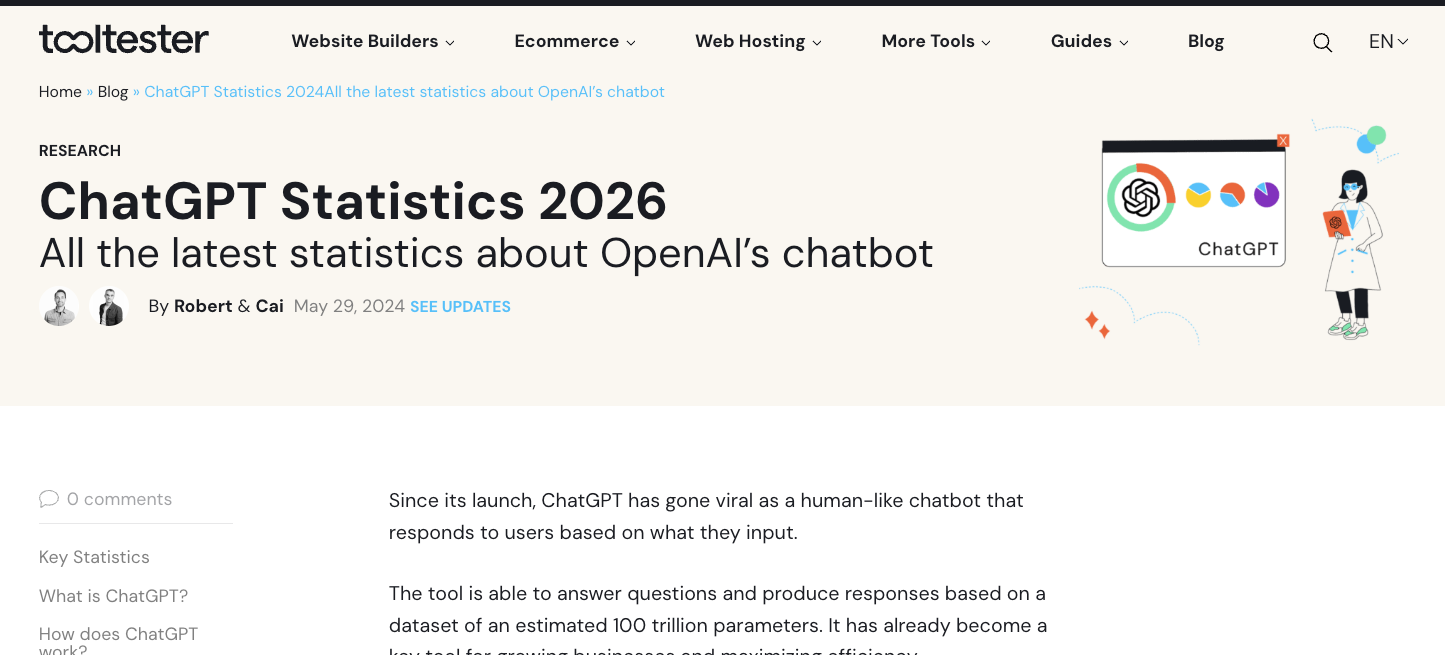
We interviewed Darren Kingman of Root Digital about how he did this for a client around a ChatGPT Statistics post.
The post in question ranks for “chatGPT statistics,” which gets about 300 monthly searches.
This doesn’t sound large, but the term has a very high link intent, meaning researchers and writers are more likely to search for and cite what they find.
The post has accrued over 1k RD over time.
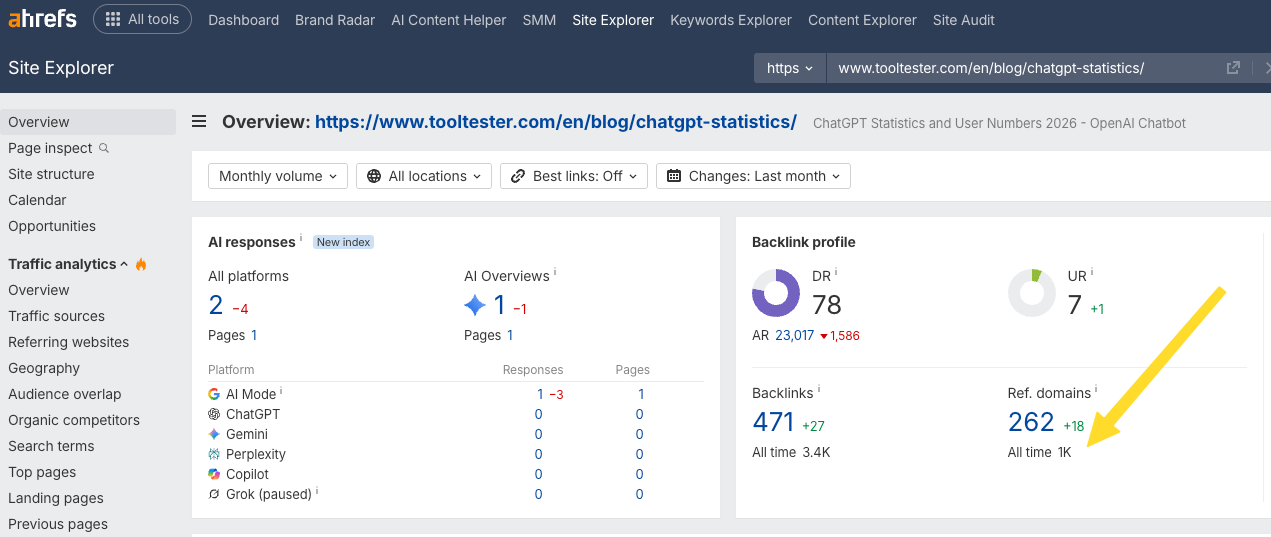
So, while the cost to produce content like this might be between $5-10k, even if your link building cost is $1,500 per link, your ROI is over 5,000%.
Not too shabby.
Let’s look at another way to consider spending on link building.
Using Monthly Lifetime Link Value
In my time with Siege Media, we leaned heavily on monthly traffic value from Ahrefs divided by number of linking root domains to get a sense of a link’s value in a given industry.
Siege Media goes further and calculates a link’s lifetime value—you can see it all in Ross’s post on the topic here.
For example, if I was trying to understand the value of a link in the link building space (we are getting a little meta here).
Let’s take Ahrefs and SEMRush, given they are two leaders in the link building space.

$3.1M/80.9K = $38.
$38 X 24 = $912
This $38 is essentially this industry’s monthly link value.
Then, let’s look at SEMRush.

$8.9M/ 114K = $78.
$78 X 24 = $1,872
These are relatively low-medium values, meaning both brands in the space can (and do) generate links reasonably easily.
This tells me that, in our case, the link building industry is fairly open to link building.
But, take an industry like personal finance, and it will start to get a little tougher.
Let’s look at Nerdwallet and Bankrate.

Using the calculation, $37.4M / 98.4K = $380.
Then, $380 X 24 = $9,120 lifetime link value.
Now, just to have another data point, let’s take Bankrate.

$27.9M / 102K = $274.
And then, $274 X 24 = $5,928 lifetime link value.
This tells me that you should be willing to spend more on link building in the finance space because building links to the industry itself is more challenging.
This analysis can help you understand the value of a link in your industry and whether it’s worth investing considerable time in your link-building efforts.
The Value (and Cost) of a Quality Link is Rising
Building links has become more complex in the past few years since Helpful Content was introduced (it’s been rolling out since 2022).
Google has recently done a decent job of devaluing low-quality sites. (This is evident in the many guest posts and link-insertion sites on my list that were nerfed to zero traffic.)
Combine that with the fact that more and more link builders are turning to digital PR because of AI visibility, and the pool of available quality sites is shrinking.
You must also consider that publications are cutting journalists altogether or pushing the remaining ones into quasi-editorial roles as publications dabble in SEO-driven content.
I expect link-building costs to rise in 2027, which is a good thing. As the actual value of a quality link increases, it should force out the spammy link building practices, link vendors, and marketplaces selling off low-quality links.
It will force those remaining to focus on the quality of backlinks, not the quantity, which is more important for your success.
Learn more about how many backlinks you need.
Backlink Cost FAQ
How much does a backlink cost in 2026?
A quality, non-syndicated, dofollow backlink costs about $1,500. Lower-quality marketplace links average $179 for insertions, $295 for direct guest posts, and $461 for vendor guest posts.
What is the average cost of a backlink?
Our averages are $179 for link insertions, $295 for direct guest posts and $461 for vendor guest posts, and a quality link costs about $1,500. Any single average hides a huge spread, which is why the DR and traffic tables matter.
How much does a backlink cost by DR?
Link insertions average $113 at DR 0 to 9, $246 at DR 30 to 39, $296 at DR 60 to 69 and $461 at DR 80+. Direct guest posts run from $132 at DR 0 to 9 to $1,735 at DR 80+, and vendor guest posts run from $196 to $2,983.
Do high-DR backlinks cost more?
Yes, but unevenly. A DR 80+ insertion costs about 4x a DR 0 to 9 insertion, and a DR 80+ direct guest post costs about 13x a DR 0 to 9 one.
How much does a guest post cost?
Direct guest posts average $295 and vendor guest posts average $461, with a range of about $150 to $10,000 on sites like Forbes.com.
How much does a link insertion cost?
Link insertions average $179, from $20 to $1,500. Sites with 100,000+ monthly visits average $510.
How much does digital PR link building cost?
About $1,250 to $1,500 per unique link, or $5,000 to $10,000 per campaign that earns roughly 6 to 7 unique linking domains.
How much does a backlink cost by industry?
Sports is the most expensive: $349 direct and $572 through a vendor for a guest post, and $345 for an insertion. Law & Government is the cheapest insertion industry at $126.
How much more do vendors charge than going direct?
About 56% more for guest posts ($461 vs. $295 on average). By DR band the gap runs from 48% to 72%.
How much does link building cost per month?
Agency retainers run about $2,500 to $10,000 a month. The typical tier is $2,500 to $5,000 for roughly 4 to 10 links, or about $250 to $1,250 per link. Those figures come from agencies’ own published pricing, not our data.
What is a link building agency?
A team that finds, pitches and places links for you. Agencies charge per link ($600 to 1,500forahigh-authorityeditoriallink),percampaign(5,000 to $10,000 for digital PR), or on a monthly retainer.
Why are some backlinks $50 and others $500?
DR, traffic, niche and the work involved set the price. The $50 links usually come from low-traffic sites, and few pass quality checks: only 1.37% of guest post sites and about 2% of link insertion offers in our analysis did.
Are cheap backlinks worth it?
Usually not. About 98% of the insertion offers we analyzed came from lower-quality sites, and many cheap vendor posts are AI-written, link to unrelated sites and use exact-match anchors.
Is buying backlinks safe?
Paid links fall under Google’s link spam policies, and few paid placements use rel=”sponsored”. Vet the site’s traffic, relevance and outbound links, and decide on disclosure knowingly.
Will backlink prices go up?
I expect so. Helpful Content updates and recent Spam updates have devalued low-quality sites, and more link builders are competing for the same quality publications.
Should you buy backlinks?
Only from sites that pass a quality check. About 98% of the link insertion offers we analyzed came from lower-quality sites, and only 1.37% of guest post sites met our bar. If you do buy, run the quote through the six checks above. Digital PR earns links instead of buying them.
Is it worth paying for backlinks?
It’s worth it when the link’s lifetime value beats its price. A $1,500 link falls short of the 912lifetimevalueofanAhrefs-sizedlinkbutpaysbackabout6xforaNerdWallet-sizedlink(9,120).
Is buying backlinks illegal?
No. But Google’s link spam policies treat paid links as spam unless they’re disclosed with rel=sponsored, and few paid placements do that. The risk is to your rankings, not a legal one.
Are backlinks still relevant in 2026?
Yes, and good ones are worth more than they used to be. Digital PR can positively influence SEO, with organic traffic climbing as links come in, while low-quality links keep losing value.



 Check out the BuzzStream Podcast